Document & post

VBIF and CCPT - In Action - Part 4

Captured 13 August 2026 · LinkedIn displayed “8mo •” at capture. Original publication date unverified.

Read the original LinkedIn post Jump to original text ↓
CCPT & sustainable financeSME transition cases

Original illustrated document

5 pages to explore

Download PDF (717 KB)
Page 1 of VBIF and CCPT - In Action - Part 4. Read the extracted page text below or open the original PDF.

Page 1 of 5

Read the document text, page by page

Automatically extracted from the original PDF. Reading order and symbols may differ from the designed pages; the PDF remains the authoritative visual version.

Page 1

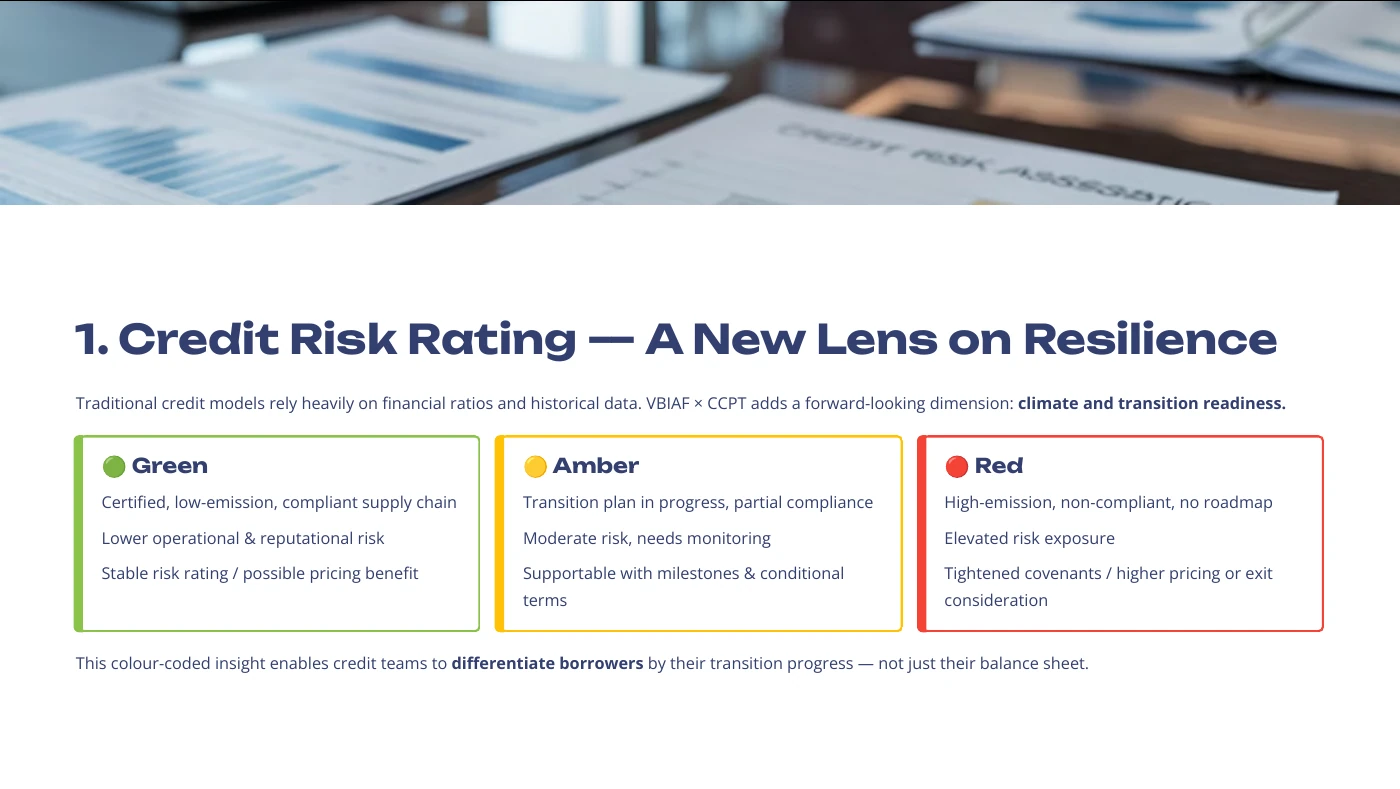
1. Credit Risk Rating 4 A New Lens on Resilience Traditional credit models rely heavily on financial ratios and historical data. VBIAF × CCPT adds a forward-looking dimension: climate and transition readiness.  Green Certified, low-emission, compliant supply chain Lower operational & reputational risk Stable risk rating / possible pricing benefit ÿ Amber Transition plan in progress, partial compliance Moderate risk, needs monitoring Supportable with milestones & conditional terms /g6D5 Red High-emission, non-compliant, no roadmap Elevated risk exposure Tightened covenants / higher pricing or exit consideration This colour-coded insight enables credit teams to differentiate borrowers by their transition progress 4 not just their balance sheet.

Page 2

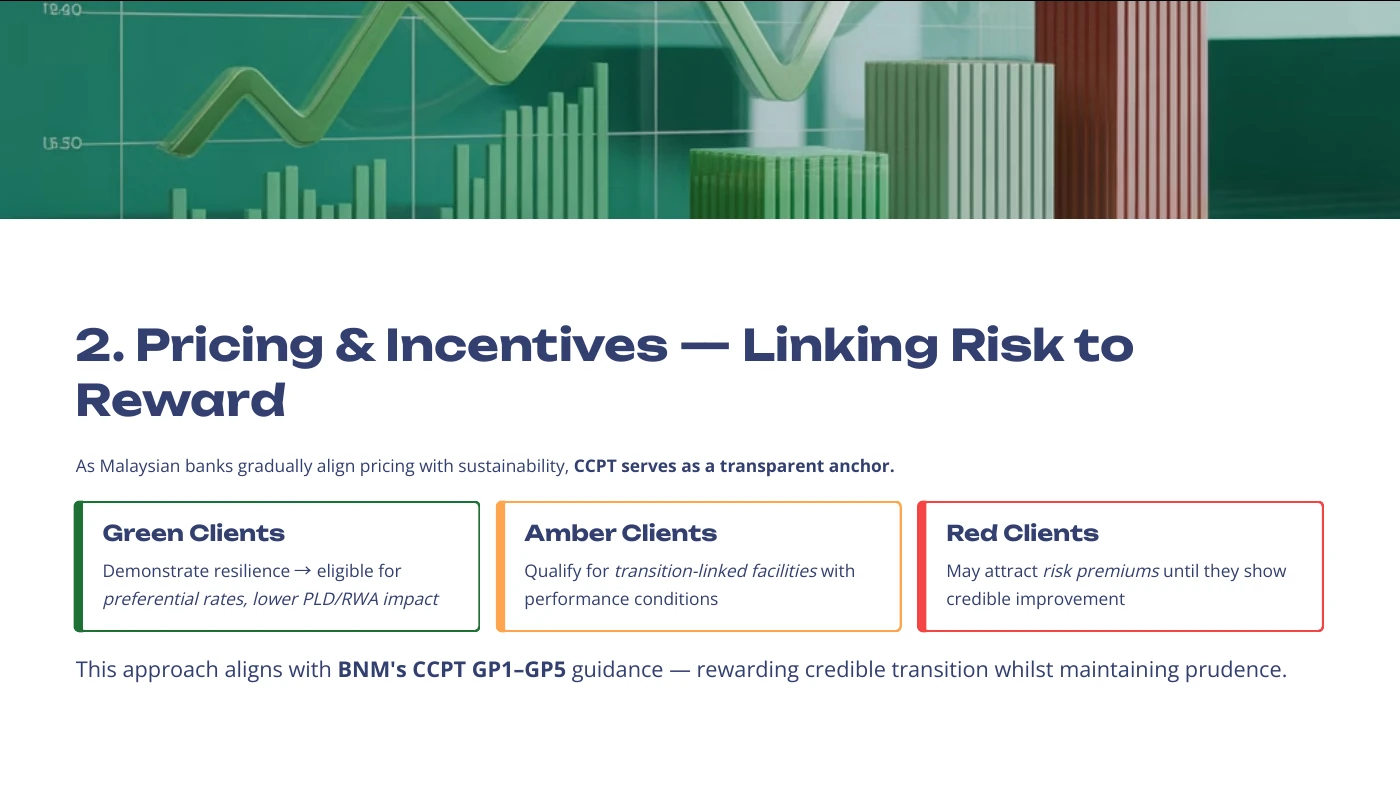
2. Pricing & Incentives 4 Linking Risk to Reward As Malaysian banks gradually align pricing with sustainability, CCPT serves as a transparent anchor. Green Clients Demonstrate resilience ³ eligible for preferential rates, lower PLD/RWA impact Amber Clients Qualify for transition-linked facilities with performance conditions Red Clients May attract risk premiums until they show credible improvement This approach aligns with BNM's CCPT GP13GP5 guidance 4 rewarding credible transition whilst maintaining prudence.

Page 3

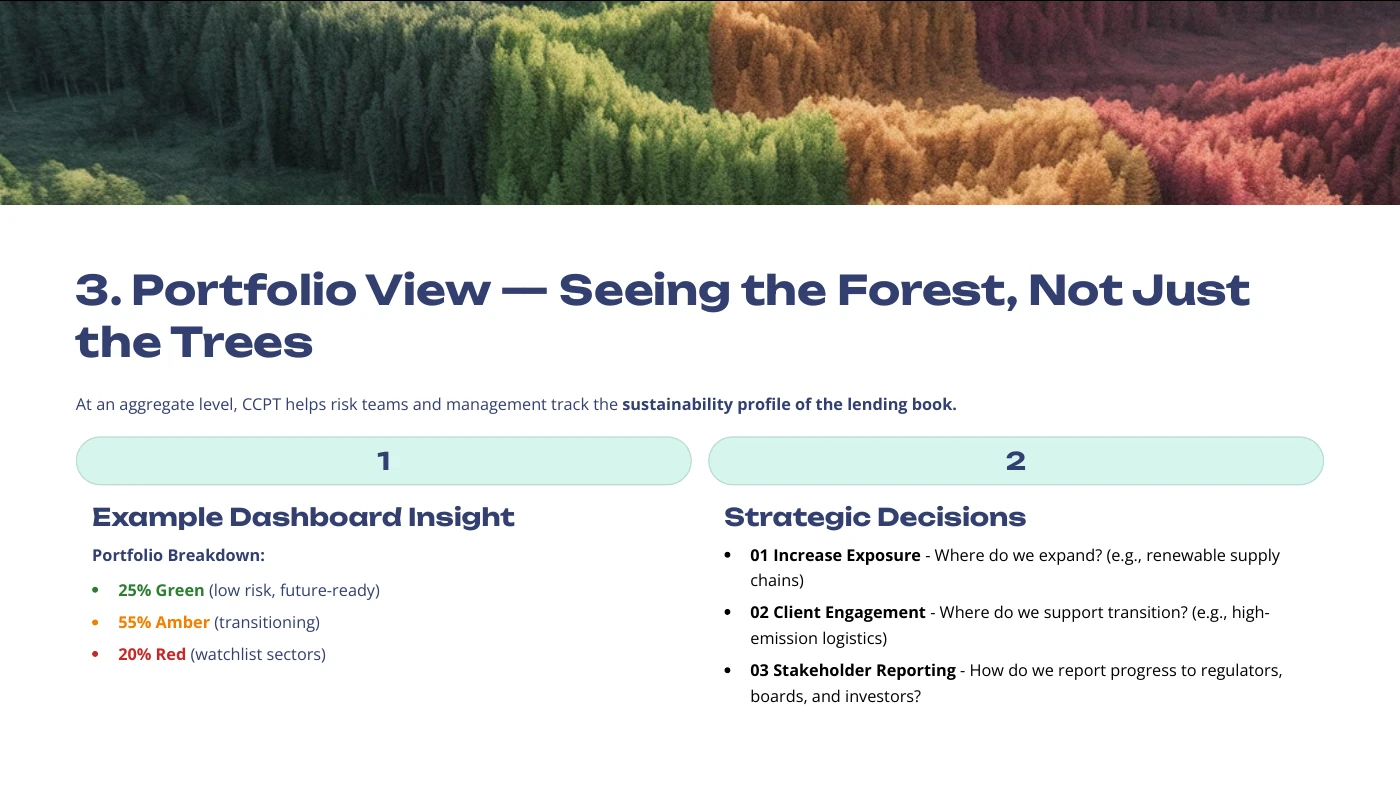
3. Portfolio View 4 Seeing the Forest, Not Just the Trees At an aggregate level, CCPT helps risk teams and management track the sustainability profile of the lending book. 1 Example Dashboard Insight Portfolio Breakdown: 25% Green (low risk, future-ready) 55% Amber (transitioning) 20% Red (watchlist sectors) 2 Strategic Decisions 01 Increase Exposure - Where do we expand? (e.g., renewable supply chains) 02 Client Engagement - Where do we support transition? (e.g., high- emission logistics) 03 Stakeholder Reporting - How do we report progress to regulators, boards, and investors?

Page 4

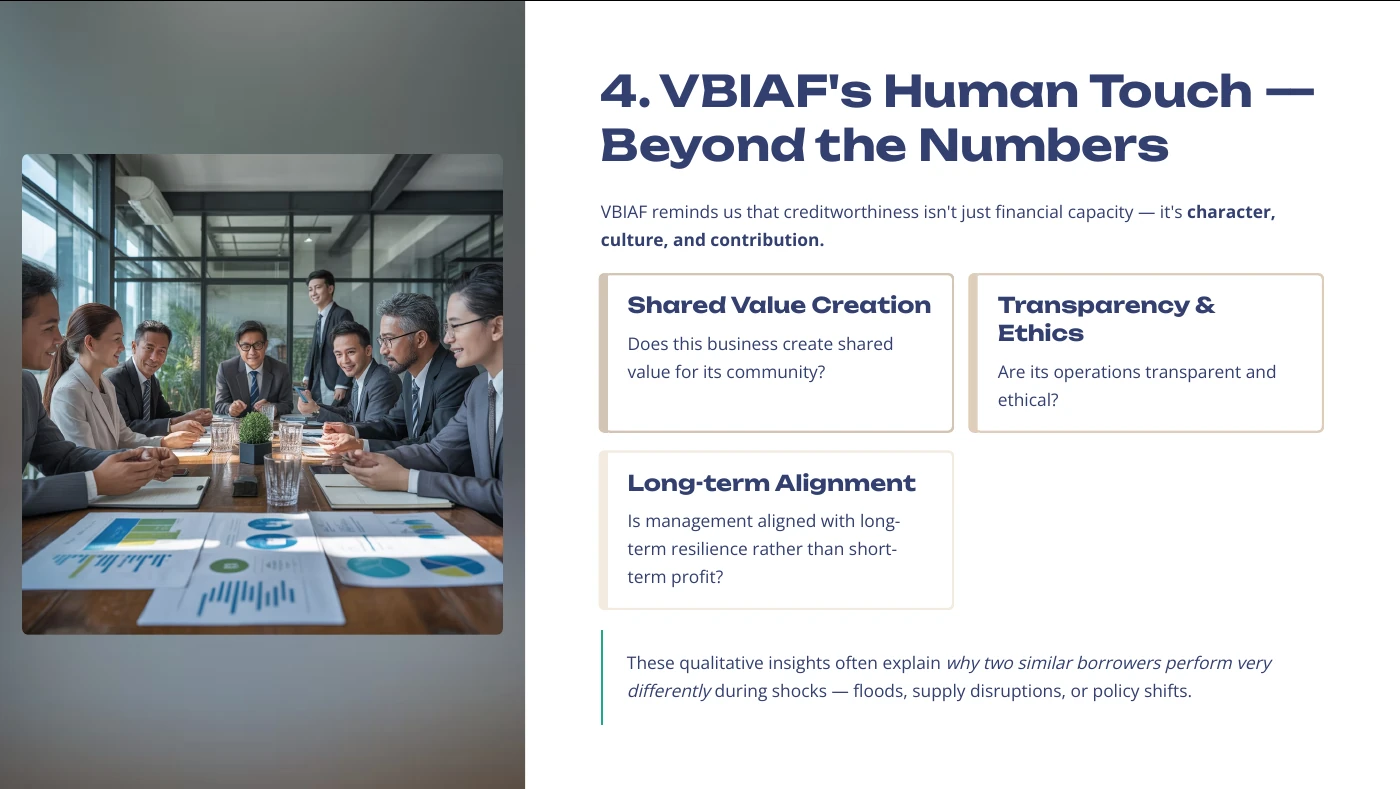
4. VBIAF's Human T ouch 4 Beyond the Numbers VBIAF reminds us that creditworthiness isn't just financial capacity 4 it's character, culture, and contribution. Shared Value Creation Does this business create shared value for its community? Transparency & Ethics Are its operations transparent and ethical? Long-term Alignment Is management aligned with long- term resilience rather than short- term profit? These qualitative insights often explain why two similar borrowers perform very differently during shocks 4 floods, supply disruptions, or policy shifts.

Page 5

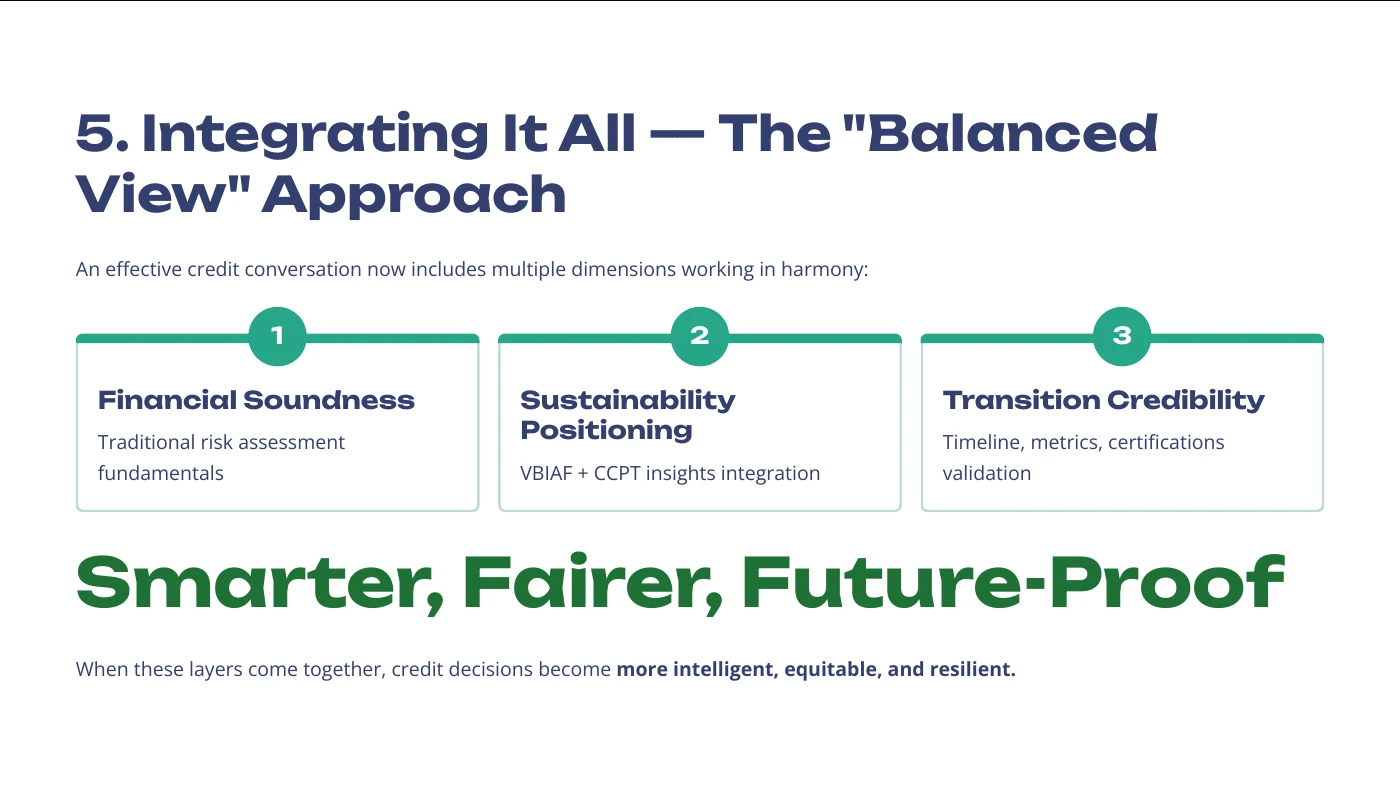
5. Integrating It All 4 The "Balanced View" Approach An effective credit conversation now includes multiple dimensions working in harmony: 1 Financial Soundness Traditional risk assessment fundamentals 2 Sustainability Positioning VBIAF + CCPT insights integration 3 Transition Credibility Timeline, metrics, certifications validation Smarter , Fairer , Future-Proof When these layers come together, credit decisions become more intelligent, equitable, and resilient.

Open the complete original PDF

In Yasotha’s words

Original post

Inside the Credit Room - How VBIAF & CCPT Strengthen Risk and Opportunity Assessment (VBIAF × CCPT in Action 4)

In the last post, we saw how Relationship Managers can start the sustainability conversation with SMEs, not as a compliance checklist, but as a pathway for growth and trust.

But what happens after that conversation?

Once the file lands on the credit officer’s desk or in the portfolio review room - how do VBIAF and CCPT actually shape the lending view?

📌 From Conversation to Classification Here’s where the frameworks come alive:

🔒 VBIAF helps us understand intent: the WHY behind a borrower’s sustainability journey. 🔒 CCPT gives us the evidence: WHERE the borrower stands today and HOW credible their transition plan is.

Together, they give bankers a 3D view of both risk and potential - Refer to Slides.

Reflection from a Banker’s Lens:

Sustainability isn’t a new department - it’s an evolution of credit wisdom. Just as we once learned to assess trade cycles, now we’re learning to assess transition cycles.

The question is no longer “Can this borrower repay?” but “Can this business remain relevant?”

Next in the Series - In my next post, I’ll close this VBIAF × CCPT series with a summary on “Sustainability as a Shared Journey - Building Banker - SME Partnerships for Transition Success.”

hashtag #SustainabilityInBanking hashtag #CCPT hashtag #VBIAF hashtag #ESGMalaysia hashtag #SMETransition hashtag #ClimateRisk hashtag #SustainableFinance hashtag #AffinBank hashtag #GreenFinance hashtag #SMEStrategy hashtag #CGM
Yasotha K.R Gopal

Banking insight. Practical learning. Thoughtful transition.

LinkedIn

Briefing enquiry

Shape a useful first conversation.

Choose a few starting points, then copy the summary into the channel you prefer. This website prepares a summary; it does not send a message.

Continue on LinkedIn