Document & post

Part 2 - Operational Risk Meets CCPT

Captured 13 August 2026 · LinkedIn displayed “1yr •” at capture. Original publication date unverified.

Read the original LinkedIn post Jump to original text ↓
Risk & resilience

Original illustrated document

9 pages to explore

Download PDF (641 KB)
Page 1 of Part 2 - Operational Risk Meets CCPT. Read the extracted page text below or open the original PDF.

Page 1 of 9

Read the document text, page by page

Automatically extracted from the original PDF. Reading order and symbols may differ from the designed pages; the PDF remains the authoritative visual version.

Page 1

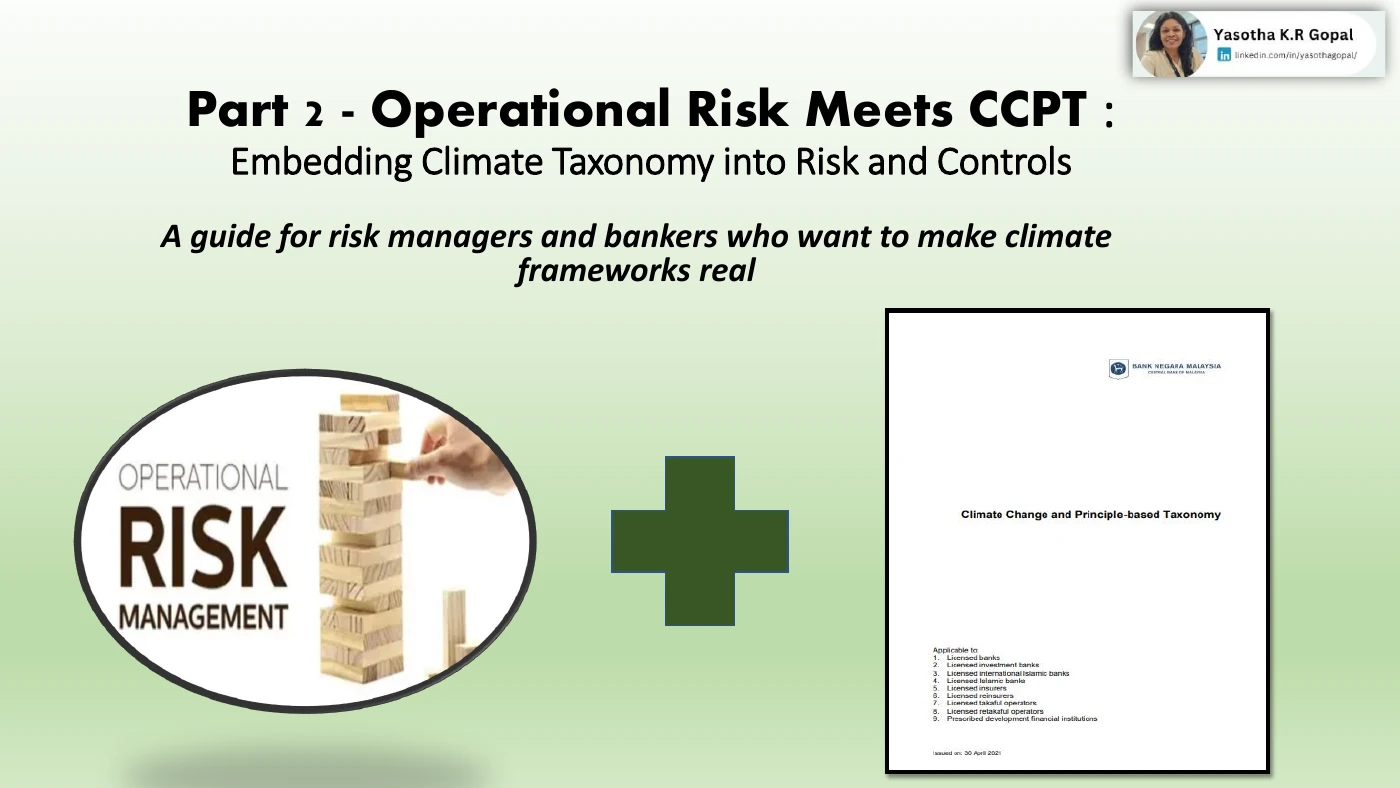
Part 2 - Operational Risk Meets CCPT : Embedding Climate Taxonomy into Risk and Controls A guide for risk managers and bankers who want to make climate frameworks real

Page 2

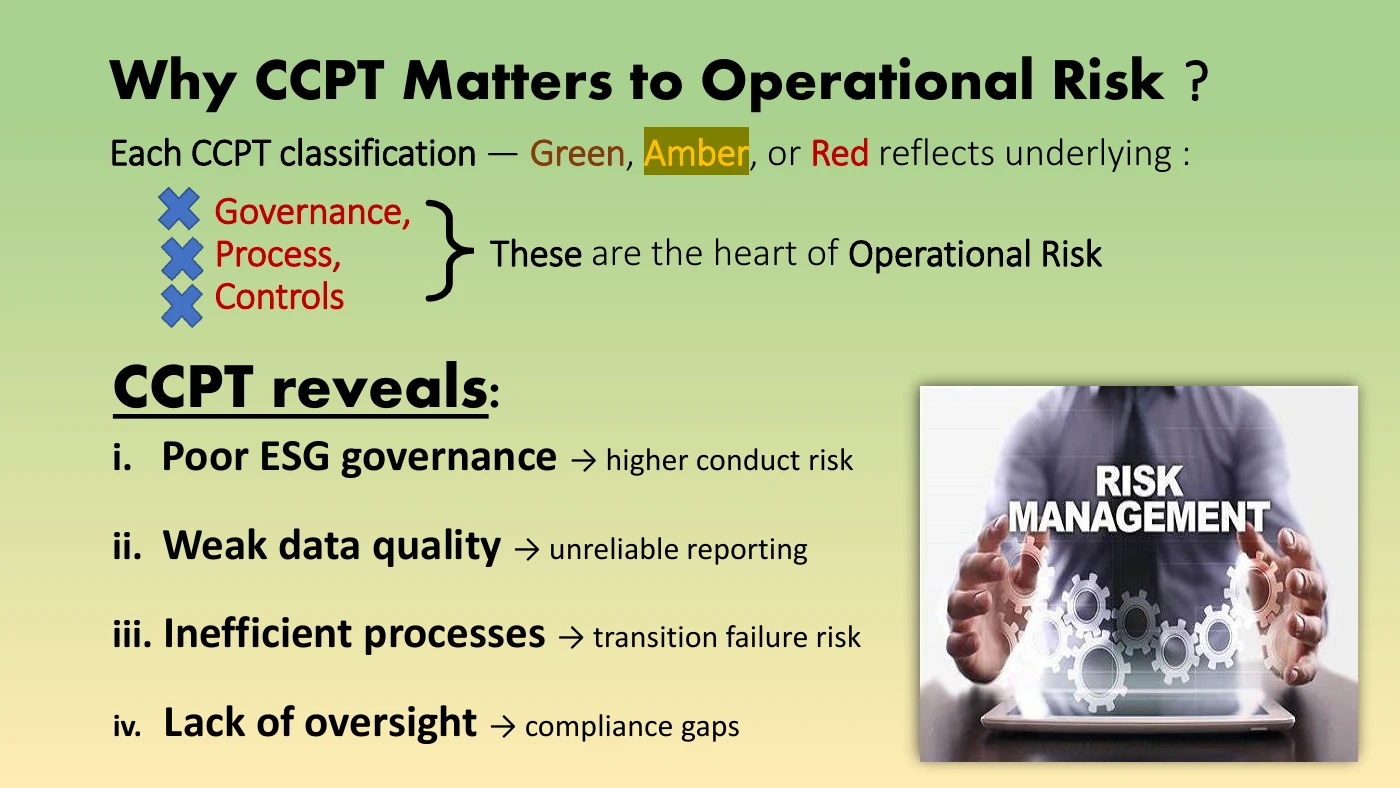
Why CCPT Matters to Operational Risk ? Each CCPT classification — Green, Amber, or Red reflects underlying : Governance, Process, These are the heart of Operational Risk Controls CCPT reveals: i. Poor ESG governance → higher conduct risk ii. Weak data quality → unreliable reporting iii. Inefficient processes → transition failure risk iv. Lack of oversight → compliance gaps

Page 3

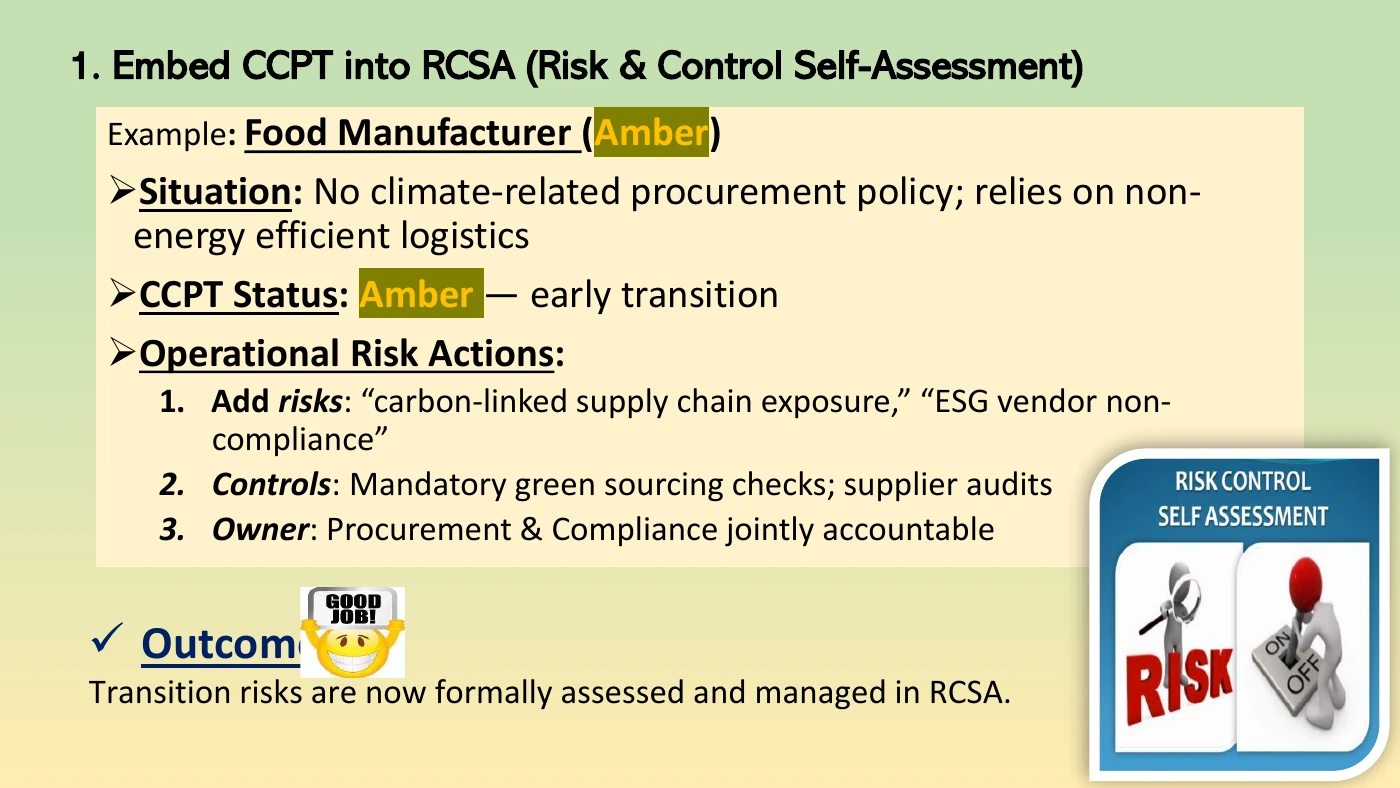
1. Embed CCPT into RCSA (Risk & Control Self-Assessment) Example: Food Manufacturer (Amber) ➢Situation: No climate-related procurement policy; relies on non- energy efficient logistics ➢CCPT Status: Amber — early transition ➢Operational Risk Actions: 1. Add risks: “carbon-linked supply chain exposure,” “ESG vendor non- compliance” 2. Controls: Mandatory green sourcing checks; supplier audits 3. Owner: Procurement & Compliance jointly accountable ✓ Outcome: Transition risks are now formally assessed and managed in RCSA.

Page 4

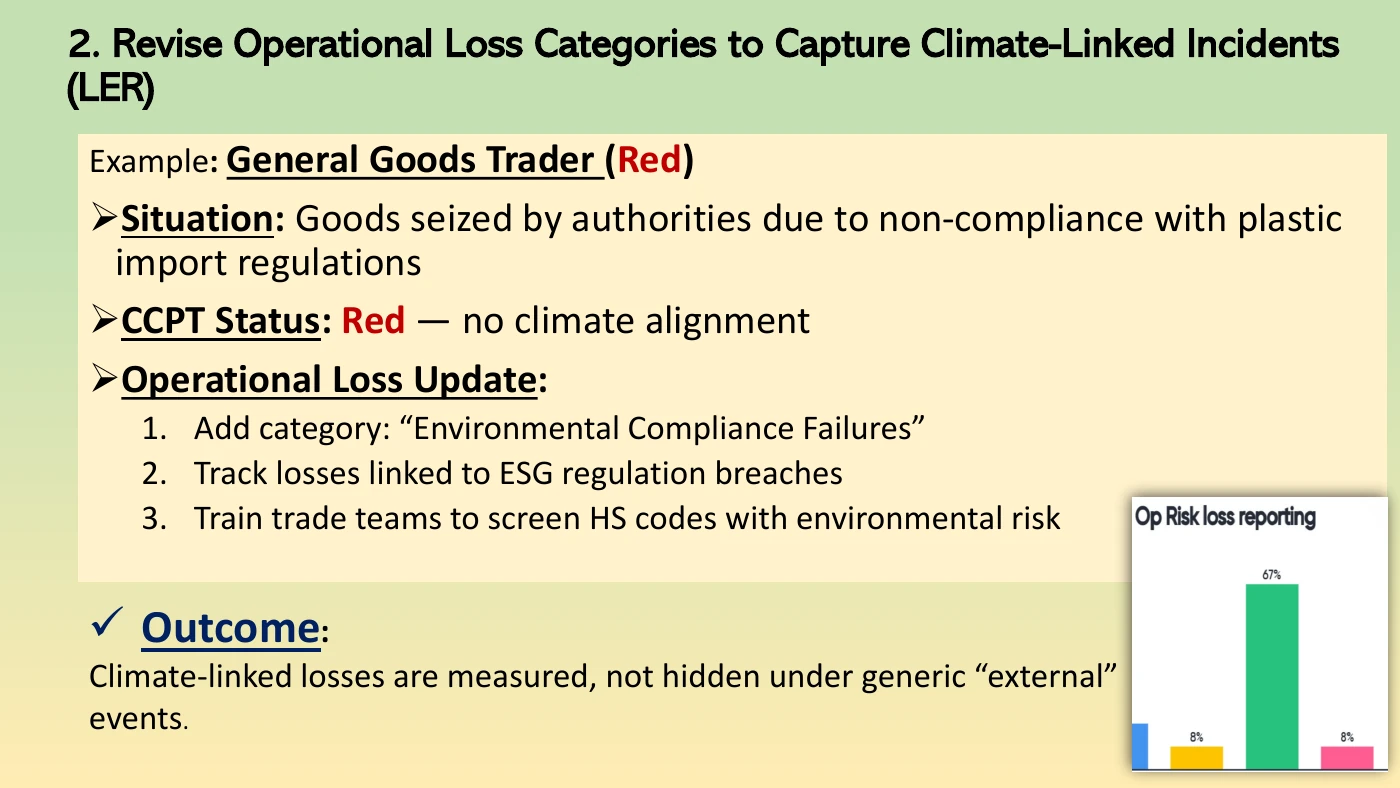
2. Revise Operational Loss Categories to Capture Climate-Linked Incidents (LER) Example: General Goods Trader (Red) ➢Situation: Goods seized by authorities due to non-compliance with plastic import regulations ➢CCPT Status: Red — no climate alignment ➢Operational Loss Update: 1. Add category: “Environmental Compliance Failures” 2. Track losses linked to ESG regulation breaches 3. Train trade teams to screen HS codes with environmental risk ✓ Outcome: Climate-linked losses are measured, not hidden under generic “external” events.

Page 5

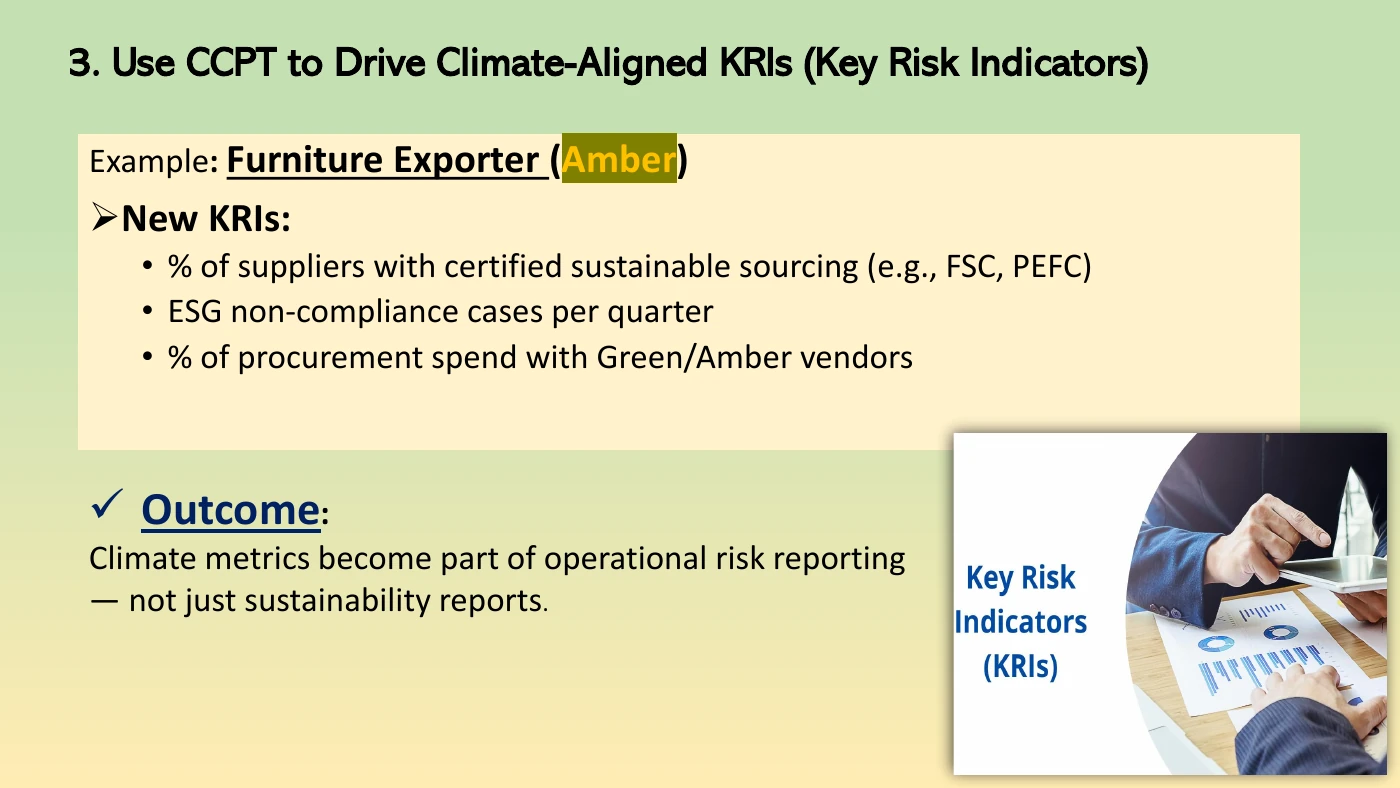
3. Use CCPT to Drive Climate-Aligned KRIs (Key Risk Indicators) Example: Furniture Exporter (Amber) ➢New KRIs: • % of suppliers with certified sustainable sourcing (e.g., FSC, PEFC) • ESG non-compliance cases per quarter • % of procurement spend with Green/Amber vendors ✓ Outcome: Climate metrics become part of operational risk reporting — not just sustainability reports.

Page 6

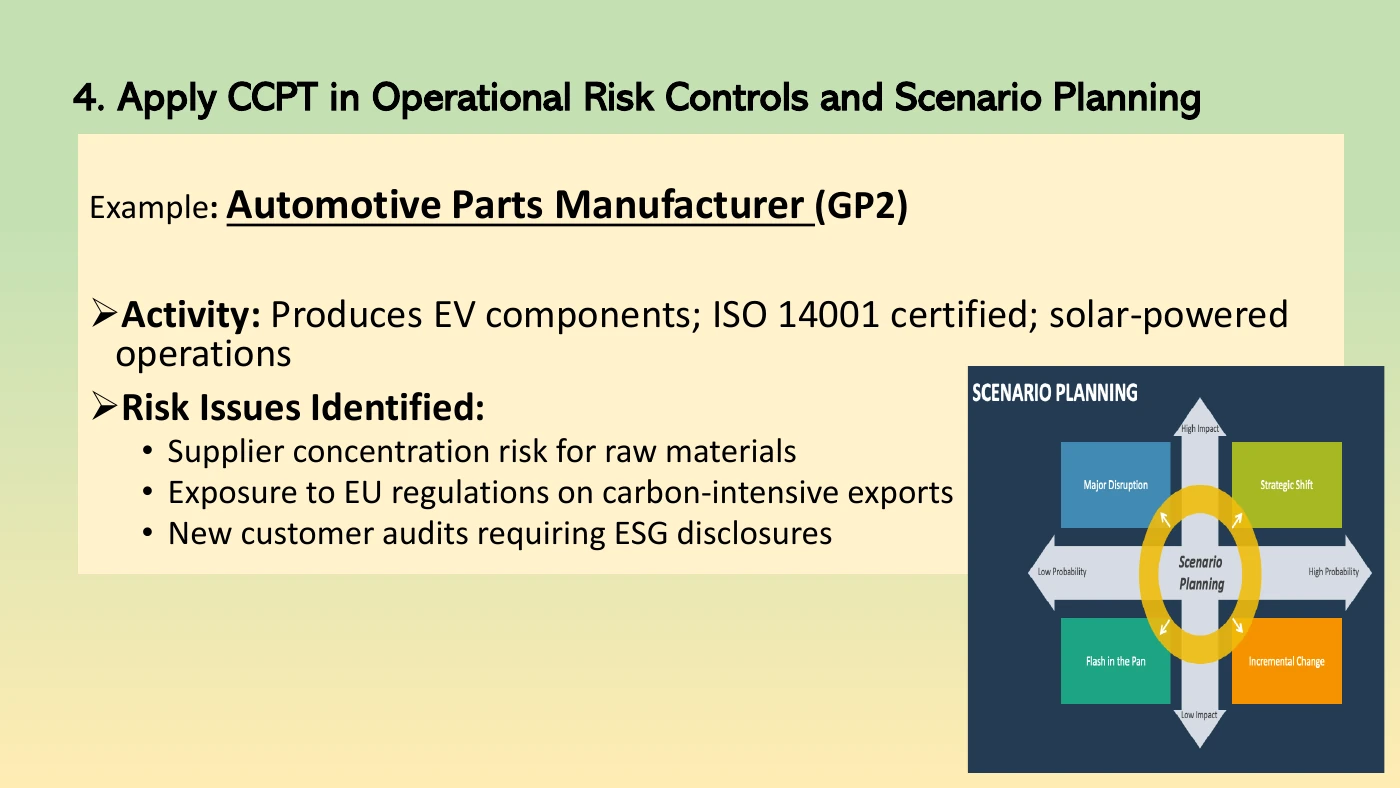
4. Apply CCPT in Operational Risk Controls and Scenario Planning Example: Automotive Parts Manufacturer (GP2) ➢Activity: Produces EV components; ISO 14001 certified; solar-powered operations ➢Risk Issues Identified: • Supplier concentration risk for raw materials • Exposure to EU regulations on carbon-intensive exports • New customer audits requiring ESG disclosures

Page 7

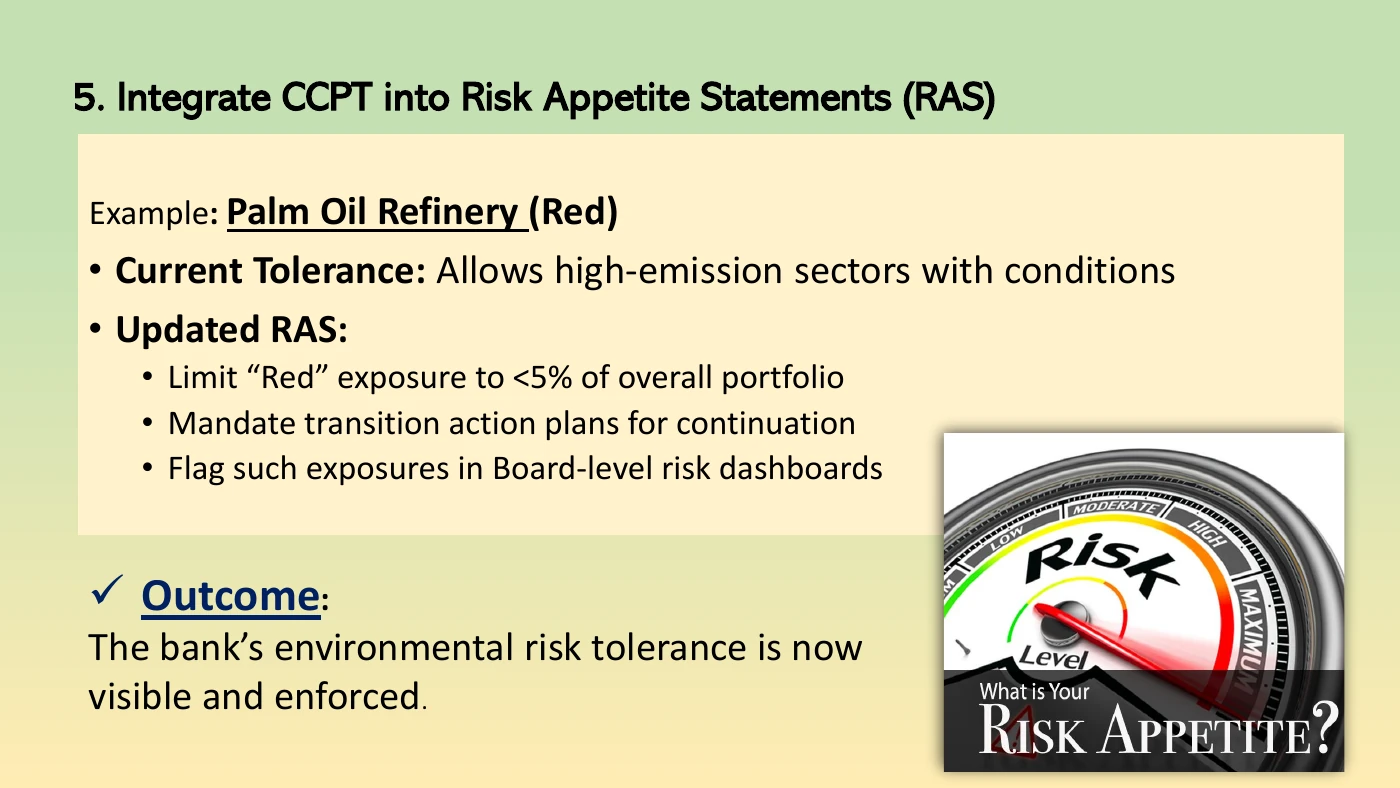
5. Integrate CCPT into Risk Appetite Statements (RAS) Example: Palm Oil Refinery (Red) • Current Tolerance: Allows high-emission sectors with conditions • Updated RAS: • Limit “Red” exposure to <5% of overall portfolio • Mandate transition action plans for continuation • Flag such exposures in Board-level risk dashboards ✓ Outcome: The bank’s environmental risk tolerance is now visible and enforced.

Page 8

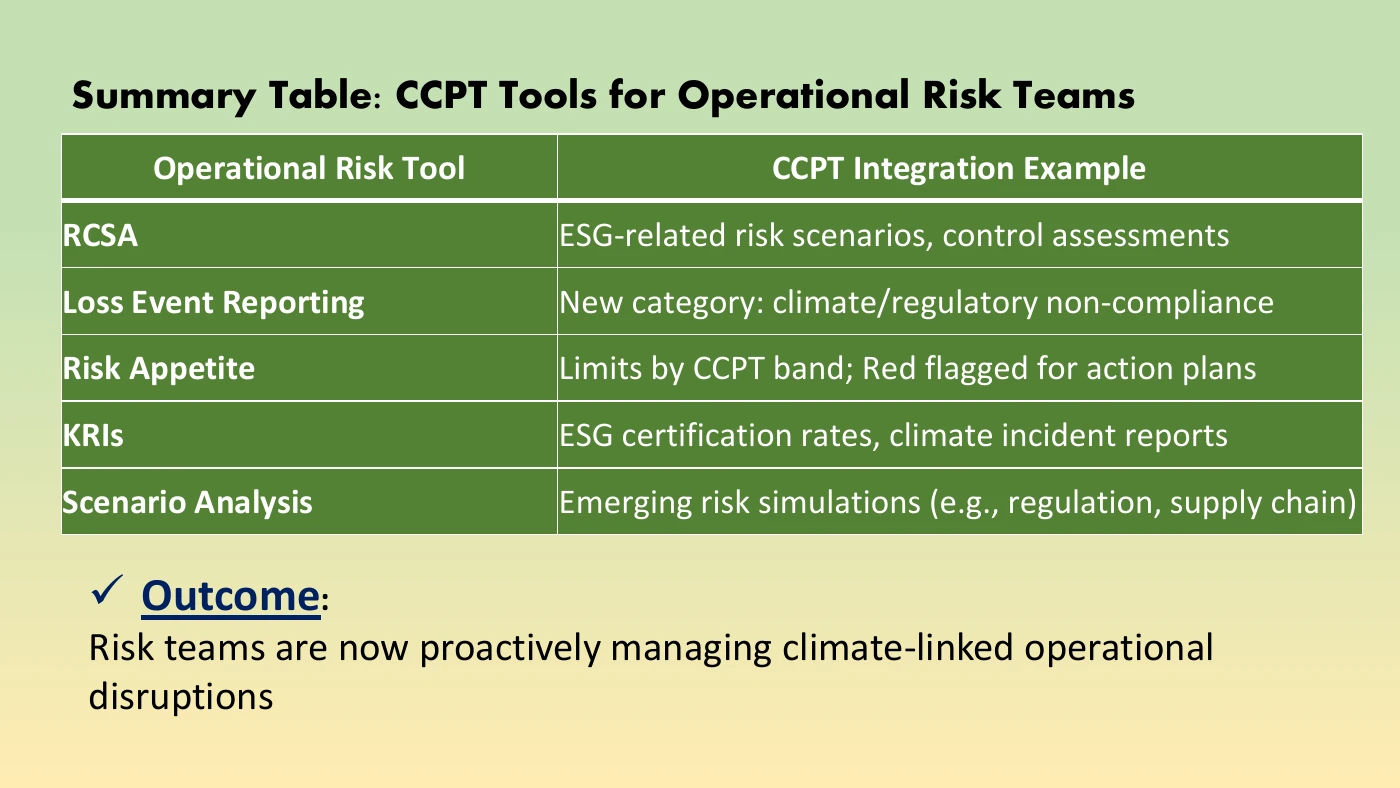
Summary Table: CCPT Tools for Operational Risk Teams ✓ Outcome: Risk teams are now proactively managing climate-linked operational disruptions Operational Risk Tool CCPT Integration Example RCSA ESG-related risk scenarios, control assessments Loss Event Reporting New category: climate/regulatory non-compliance Risk Appetite Limits by CCPT band; Red flagged for action plans KRIs ESG certification rates, climate incident reports Scenario Analysis Emerging risk simulations (e.g., regulation, supply chain)

Page 9

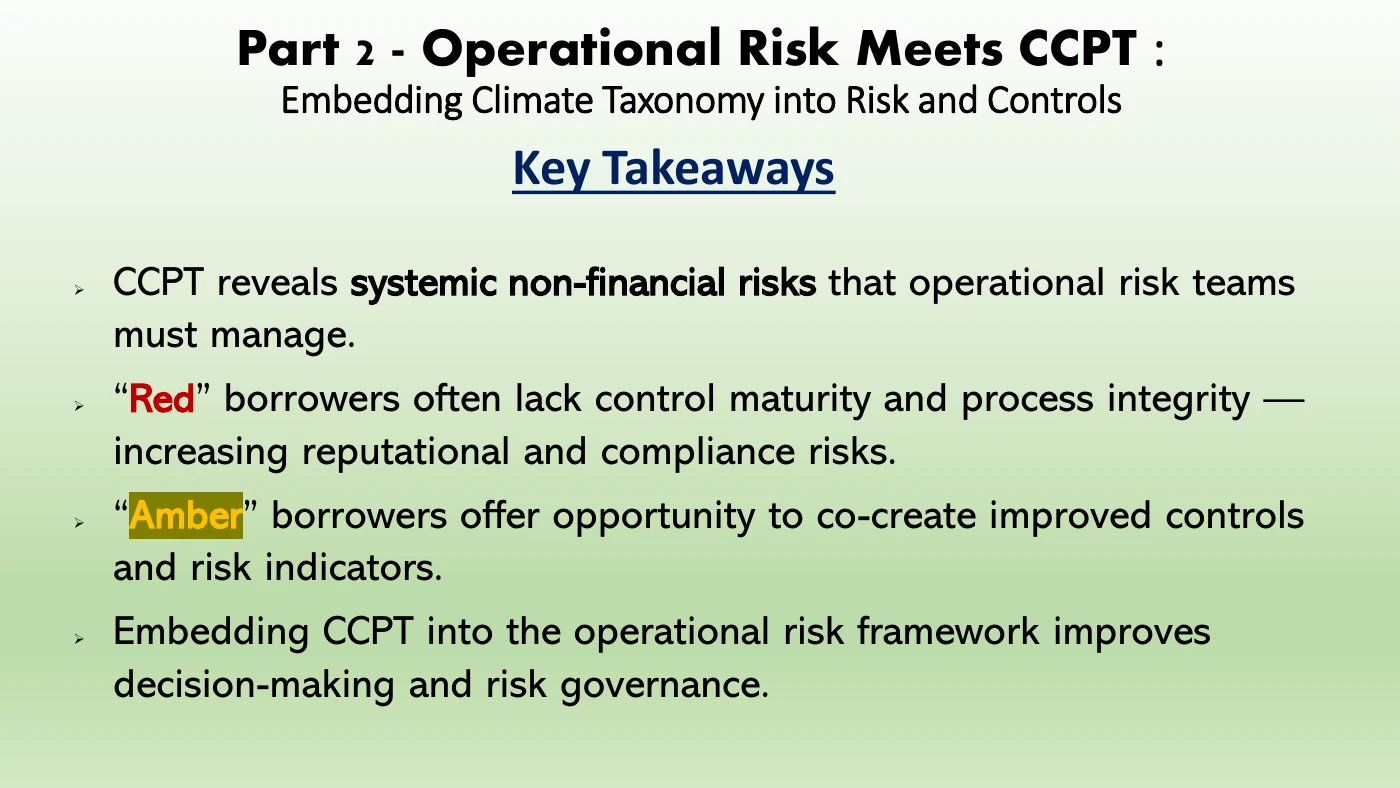
Part 2 - Operational Risk Meets CCPT : Embedding Climate Taxonomy into Risk and Controls Key Takeaways ➢ CCPT reveals systemic non-financial risks that operational risk teams must manage. ➢ “Red” borrowers often lack control maturity and process integrity — increasing reputational and compliance risks. ➢ “Amber” borrowers offer opportunity to co-create improved controls and risk indicators. ➢ Embedding CCPT into the operational risk framework improves decision-making and risk governance.

Open the complete original PDF

In Yasotha’s words

Original post

Operational Risk Meets CCPT: Embedding Climate Taxonomy into Risk and Controls A guide for risk managers and bankers who want to make climate frameworks real ------------------------------------------------------------------------------------ Bank Negara Malaysia’s Climate Change and Principle-based Taxonomy (CCPT) is typically framed as an ESG or credit requirement. But those of us in the second line of defense know: CCPT has serious Operational Risk implications — and risk managers must play a central role in implementation.

As someone who’s led credit, operational risk, and business continuity functions — and is ICRP-certified — I believe that climate transition risks belong squarely within RCSA frameworks, risk appetite, and internal control environments.

To prove my point, illustrations on how Operational Risk teams can apply CCPT practically, with real examples from Malaysian industries provided in slides below.

Next, in the final article of this series, I’ll focus on Business Continuity and Climate Stress: how bankers can prepare for floods, energy shocks, and policy disruptions through stronger BCM frameworks.

Stay Tuned 😇
Yasotha K.R Gopal

Banking insight. Practical learning. Thoughtful transition.

LinkedIn

Briefing enquiry

Shape a useful first conversation.

Choose a few starting points, then copy the summary into the channel you prefer. This website prepares a summary; it does not send a message.

Continue on LinkedIn