Document & post

Part 3 - CCPT and Business Continuity

Captured 13 August 2026 · LinkedIn displayed “1yr •” at capture. Original publication date unverified.

Read the original LinkedIn post Jump to original text ↓
Risk & resilience

Original illustrated document

9 pages to explore

Download PDF (1.2 MB)
Page 1 of Part 3 - CCPT and Business Continuity. Read the extracted page text below or open the original PDF.

Page 1 of 9

Read the document text, page by page

Automatically extracted from the original PDF. Reading order and symbols may differ from the designed pages; the PDF remains the authoritative visual version.

Page 1

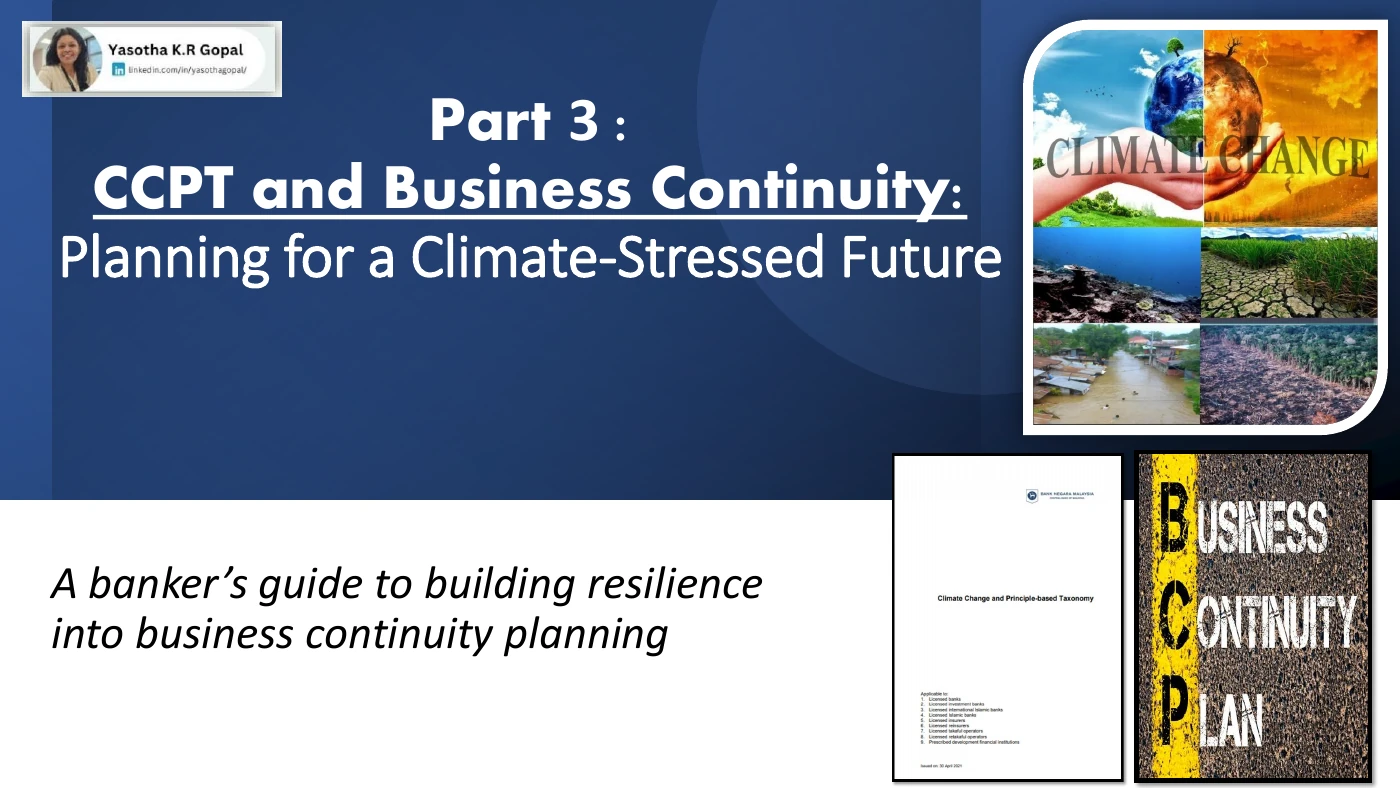
Part 3 : CCPT and Business Continuity: Planning for a Climate-Stressed Future A banker’s guide to building resilience into business continuity planning

Page 2

Why CCPT Belongs in BCP??

Page 3

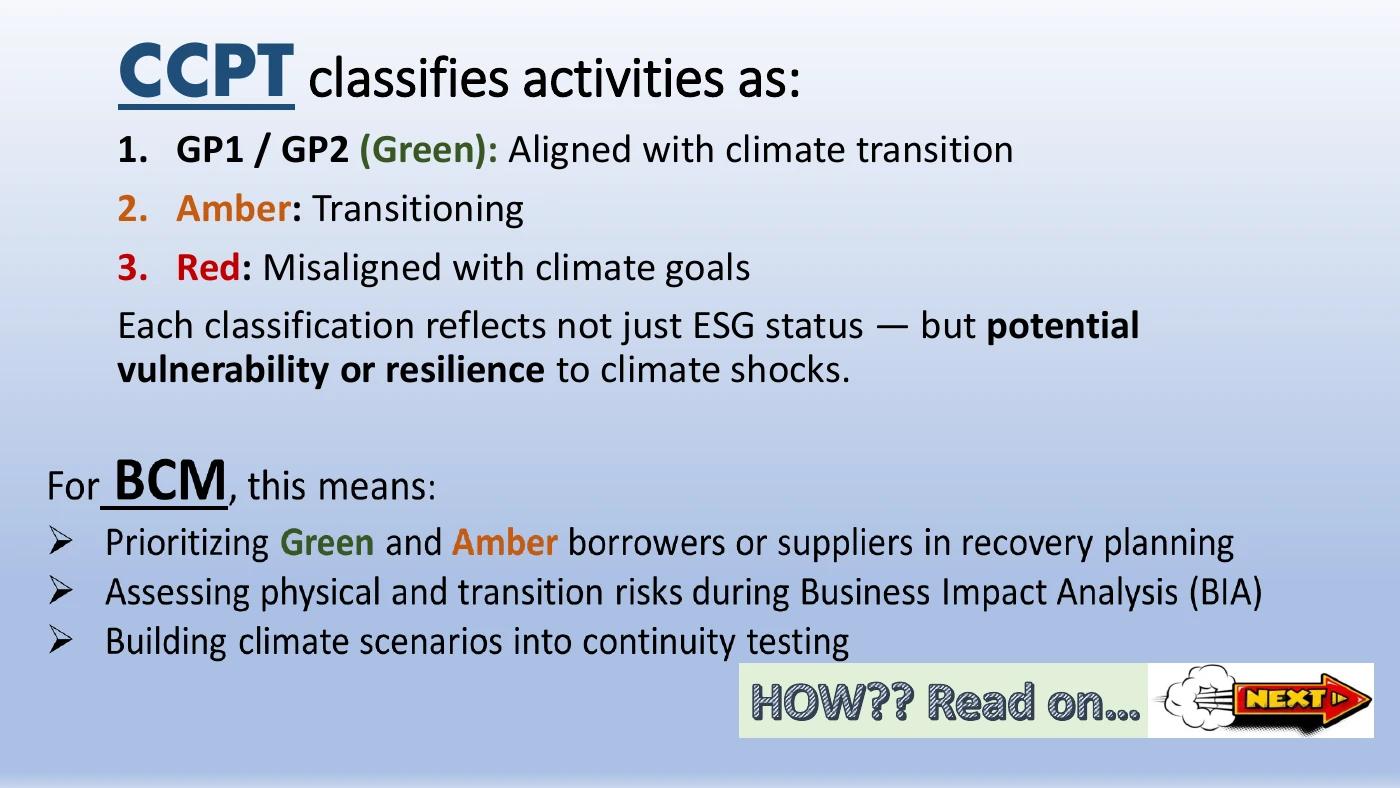
CCPT classifies activities as: 1. GP1 / GP2 (Green): Aligned with climate transition 2. Amber: Transitioning 3. Red: Misaligned with climate goals Each classification reflects not just ESG status — but potential vulnerability or resilience to climate shocks.

Page 4

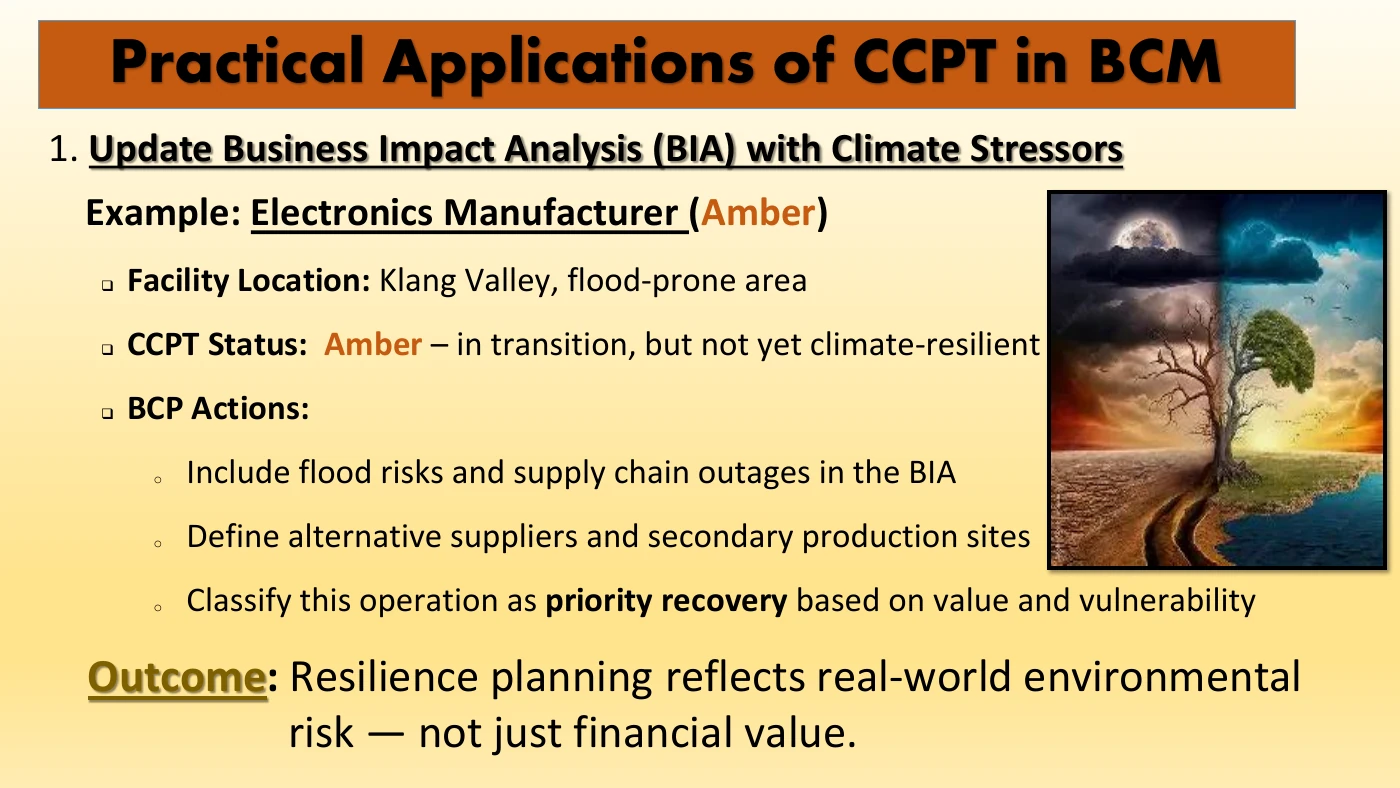
1. Update Business Impact Analysis (BIA) with Climate Stressors Example: Electronics Manufacturer (Amber) ❑ Facility Location: Klang Valley, flood-prone area ❑ CCPT Status: Amber – in transition, but not yet climate-resilient ❑ BCP Actions: o Include flood risks and supply chain outages in the BIA o Define alternative suppliers and secondary production sites o Classify this operation as priority recovery based on value and vulnerability Practical Applications of CCPT in BCM Outcome : Resilience planning reflects real-world environmental risk — not just financial value.

Page 5

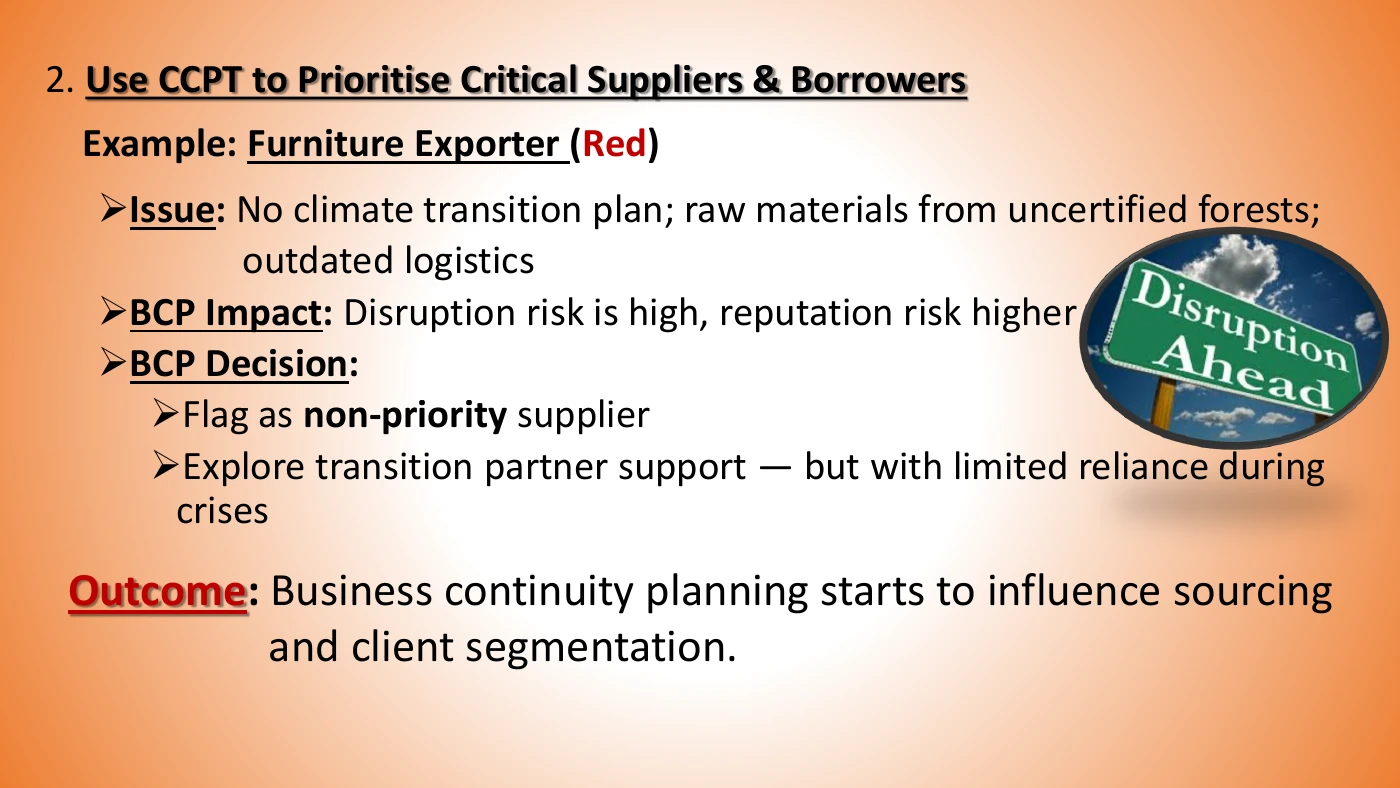
2. Use CCPT to Prioritise Critical Suppliers & Borrowers Example: Furniture Exporter (Red) ➢Issue: No climate transition plan; raw materials from uncertified forests; outdated logistics ➢BCP Impact: Disruption risk is high, reputation risk higher ➢BCP Decision: ➢Flag as non-priority supplier ➢Explore transition partner support — but with limited reliance during crises Outcome : Business continuity planning starts to influence sourcing and client segmentation.

Page 6

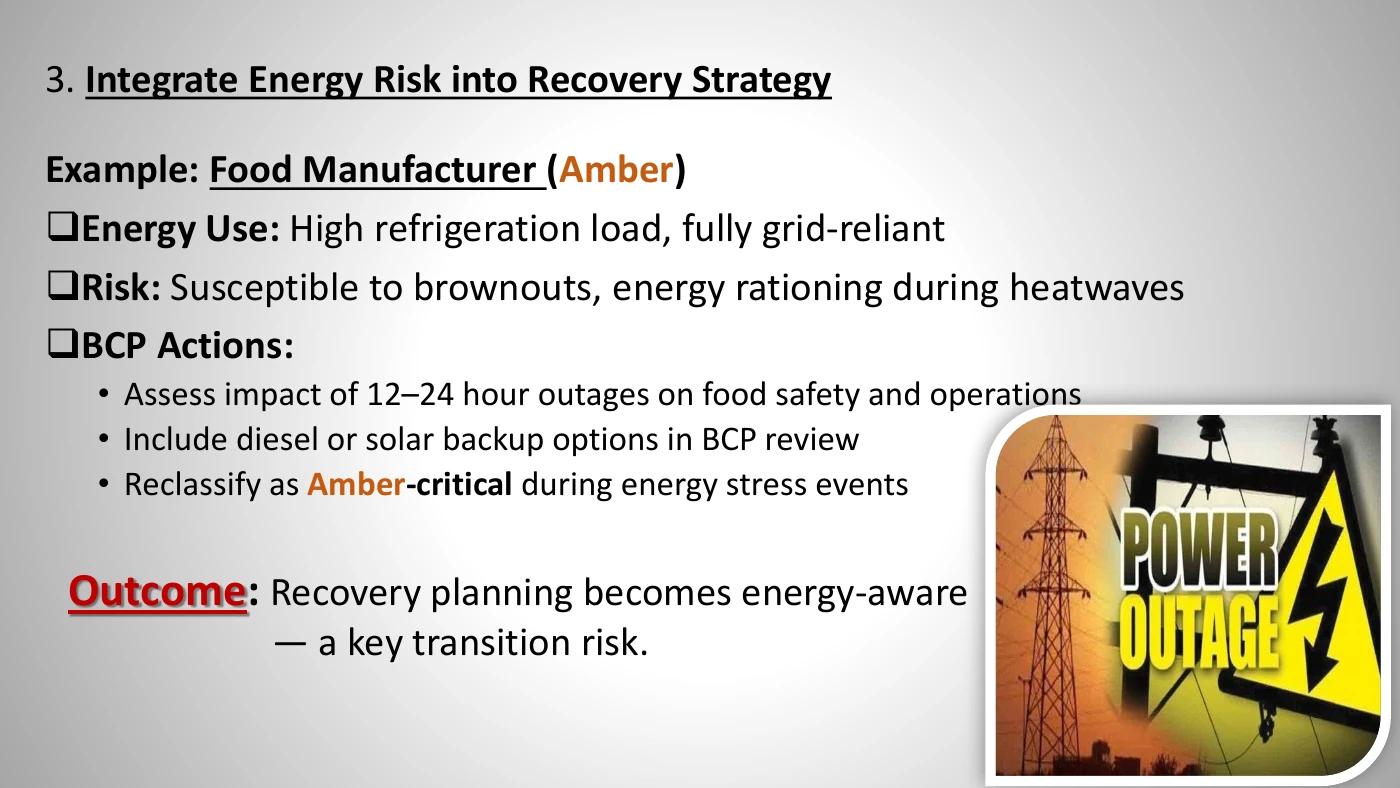
3. Integrate Energy Risk into Recovery Strategy Example: Food Manufacturer (Amber) ❑Energy Use: High refrigeration load, fully grid-reliant ❑Risk: Susceptible to brownouts, energy rationing during heatwaves ❑BCP Actions: • Assess impact of 12–24 hour outages on food safety and operations • Include diesel or solar backup options in BCP review • Reclassify as Amber-critical during energy stress events Outcome : Recovery planning becomes energy-aware — a key transition risk.

Page 7

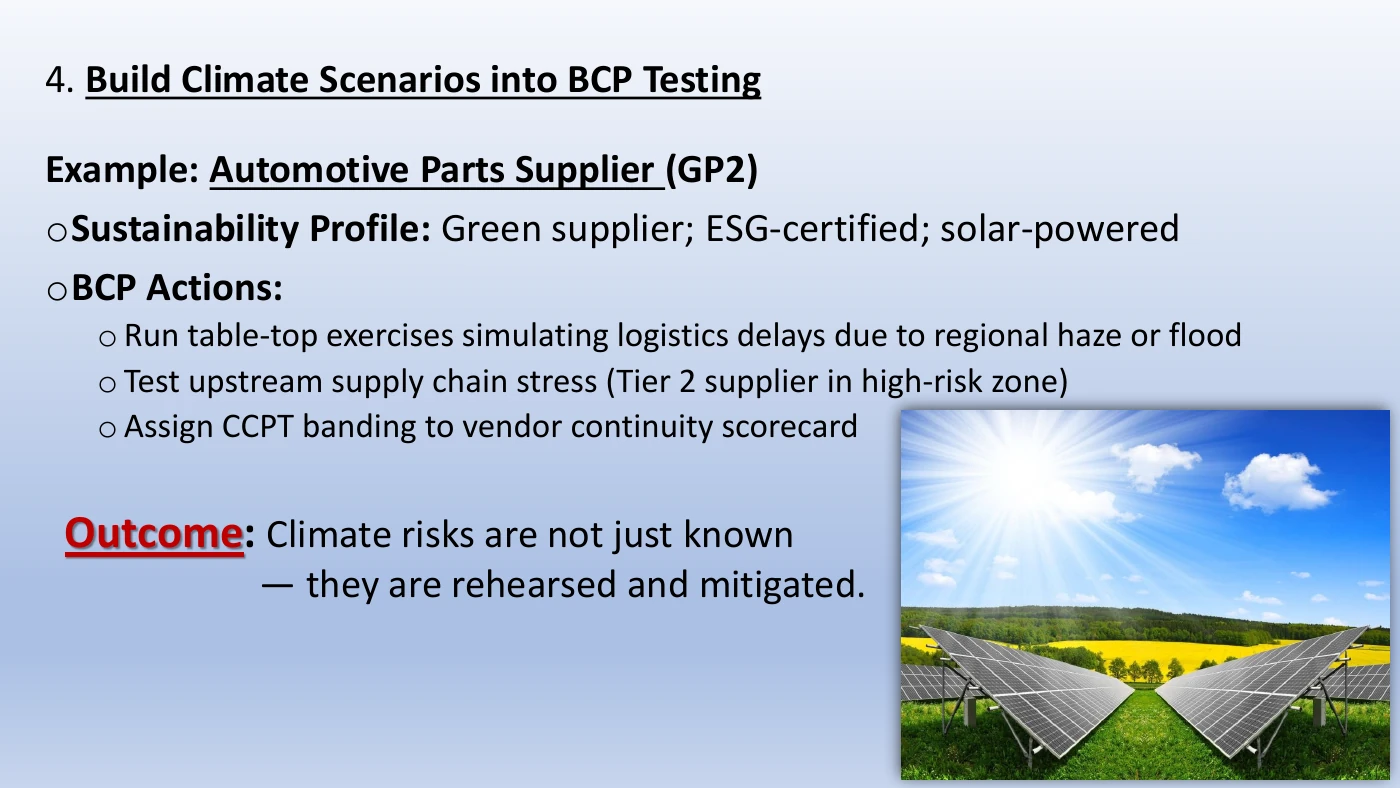
4. Build Climate Scenarios into BCP Testing Example: Automotive Parts Supplier (GP2) oSustainability Profile: Green supplier; ESG-certified; solar-powered oBCP Actions: o Run table-top exercises simulating logistics delays due to regional haze or flood o Test upstream supply chain stress (Tier 2 supplier in high-risk zone) o Assign CCPT banding to vendor continuity scorecard Outcome : Climate risks are not just known — they are rehearsed and mitigated.

Page 8

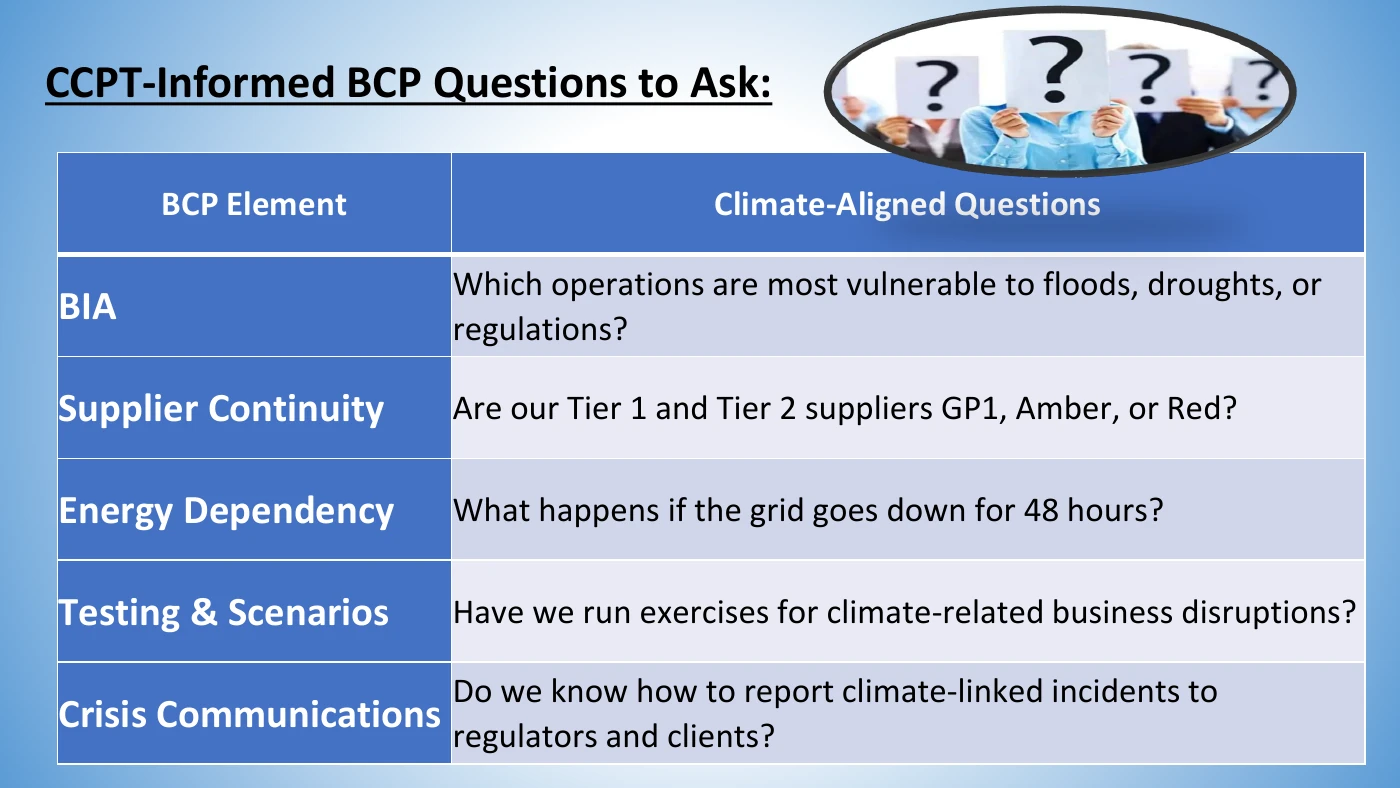
CCPT-Informed BCP Questions to Ask: BCP Element Climate-Aligned Questions BIA Which operations are most vulnerable to floods, droughts, or regulations? Supplier Continuity Are our Tier 1 and Tier 2 suppliers GP1, Amber, or Red? Energy Dependency What happens if the grid goes down for 48 hours? Testing & Scenarios Have we run exercises for climate-related business disruptions? Crisis Communications Do we know how to report climate-linked incidents to regulators and clients?

Page 9

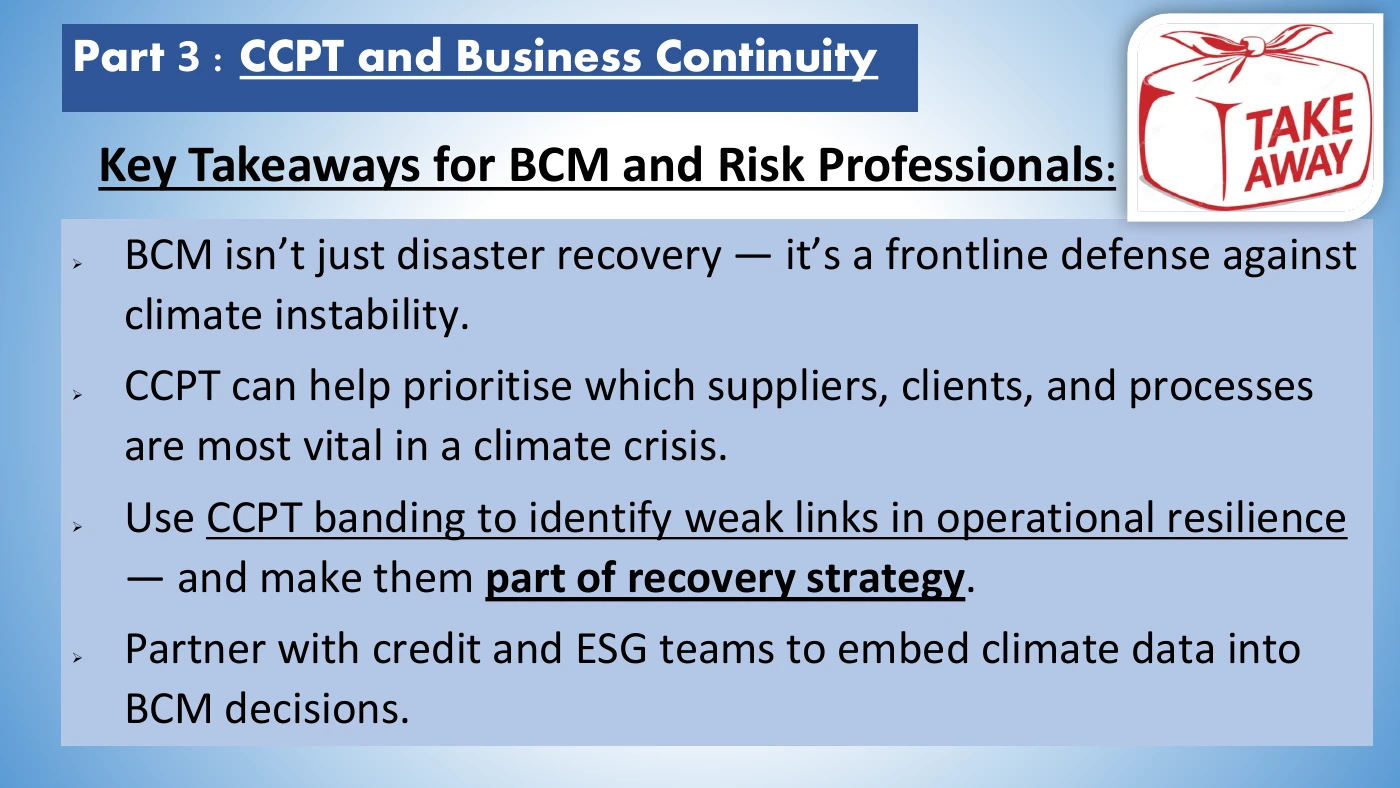
Key Takeaways for BCM and Risk Professionals: ➢ BCM isn’t just disaster recovery — it’s a frontline defense against climate instability. ➢ CCPT can help prioritise which suppliers, clients, and processes are most vital in a climate crisis. ➢ Use CCPT banding to identify weak links in operational resilience — and make them part of recovery strategy. ➢ Partner with credit and ESG teams to embed climate data into BCM decisions. Part 3 : CCPT and Business Continuity

Open the complete original PDF

In Yasotha’s words

Original post

CCPT and Business Continuity: Planning for a Climate-Stressed Future - A banker’s guide to building resilience into business continuity planning.

Floods. Droughts. Supply chain breakdowns. Energy rationing.

These aren’t distant climate scenarios — they’re operational realities for many Malaysian businesses today. As climate risks become more frequent and severe, Business Continuity Planning (BCP) is no longer just about fire drills or data backups. It’s about preparing for a climate-stressed future.

And this is where Bank Negara Malaysia’s Climate Change and Principle-based Taxonomy (CCPT) intersects with BCM (Business Continuity Management).

As someone overseeing both Operational Risk and BCM — and now ICRP-certified — I believe BCP is our underused asset in preparing for tomorrow’s banking environment. CCPT gives us the roadmap. BCM makes it real. CCPT classifications can be used to guide prioritization, scenario planning, and recovery strategies. Please refer to Slides below.

This concludes my 3-part series on “Making CCPT Work in Malaysian Banking”, where I’ve shared practical approaches across: Part 1 - Credit - From Credit Risk to Climate Risk - Applying CCPT Beyond Compliance. Part 2 - Operational Risk - Operational Risk Meets CCPT - Embedding Climate Taxonomy into Risk Controls. Part 3 - Business Continuity - CCPT and Business Continuity Planning for a Climate -Stressed Future.

If you’ve found value in this series, I’d love to connect and exchange perspectives on climate risk, ESG integration, and building institutional resilience.

Yasotha K.R Gopal

Banking insight. Practical learning. Thoughtful transition.

LinkedIn

Briefing enquiry

Shape a useful first conversation.

Choose a few starting points, then copy the summary into the channel you prefer. This website prepares a summary; it does not send a message.

Continue on LinkedIn